
Compare U.S. visa types side by side
Explore typical purposes, who files, employment limits and essential distinctions. Covering B-1/B-2, ESTA, F-1, J-1, H-1B, L-1, O-1, E-2 and K-1 — without guessing a visa for you.
Comparar visas en español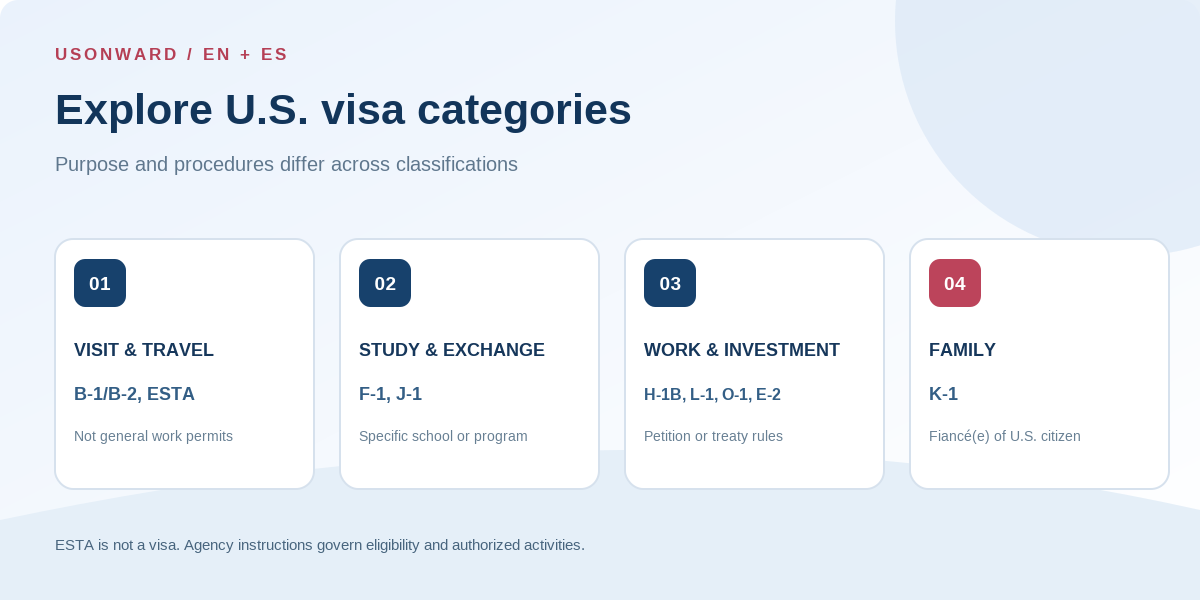
Choose the classification, not a result. These broad descriptions cannot determine whether you qualify or which process applies. Citizenship, prior travel and work history, employer eligibility, consular procedures and other facts matter. Always verify the agency instructions.
Compare two categories; topic filters organize the examples but do not determine which visa fits any individual.
| Feature | B-1/B-2 Visitor visa | F-1 Academic student |
|---|---|---|
| Typical purpose | Certain temporary business visits, tourism and permitted personal visits. | Qualifying academic or language-training studies at an eligible institution. |
| Application and petitioner | Usually applies through a U.S. embassy or consulate; the purpose of visit matters. | Requires school documentation, including an appropriate Form I-20, and relevant visa steps. |
| Employment | Does not provide general U.S. employment authorization. | Student employment is restricted and may require specific authorization. |
| Key distinction | B-1 business activities and paid employment in the U.S. are not interchangeable. | School admission, I-20 issuance, visa approval and admission are different events. |
| Explore further |
9 categories in the selected group
What to check beyond the visa label
Purpose of travel: tourism, study, an exchange program, qualifying employment, investment and joining a fiancé(e) are not interchangeable activities. A visitor visa does not provide general authorization to work, while an F-1 student's employment is governed by restrictions and special permissions.
Who files: some classifications typically begin with a consular application, others require an employer, program sponsor or U.S. citizen to initiate a petition. A petition approval, a visa being issued and entry at a U.S. port are separate legal events.
Temporary vs. permanent: the visa types above are generally temporary classifications. They are not interchangeable with an immigrant visa, adjustment of status or an approved Green Card. ESTA is an authorization under the Visa Waiver Program, not a visa.
Things that change: fee schedules, eligibility criteria, country lists, processing estimates, registration rules and instructions may be revised. Follow the government link supplied for each classification rather than relying on an old chart.
Common questions
Does an H-1B approval automatically grant a Green Card?
No. H-1B is a nonimmigrant classification. Permanent residence, when available, requires a separate legal basis and procedure.
Is ESTA the same as a B-1/B-2 visa?
No. ESTA is travel authorization used by eligible travelers under the Visa Waiver Program. Eligibility, admission rules and available actions differ from traveling with a visitor visa.
Can an F-1 student work in the United States?
Only under the employment rules and authorizations that apply to the student's situation. Admission to a school and obtaining an I-20 do not themselves create unrestricted work authorization.
Is there a universal minimum investment for E-2?
No fixed amount should be assumed for every case. Substantiality is evaluated under the relevant legal criteria and the enterprise's circumstances.
Does the K-1 visa directly grant permanent residence?
No. A person admitted with K-1 must satisfy the conditions of the classification and normally seek adjustment of status in a later, separate procedure.
Primary sources and further research
Start with the Department of State's directory of visa categories and the USCIS temporary-workers overview . The comparison also links directly to an official page and an in-depth USOnward guide for every classification.