
Understand why a U.S. consular visa case may be refused under INA 221(g), what additional documents or administrative processing may involve and how to follow official instructions.
What is a refusal under INA 221(g)?
Section 221(g) of the Immigration and Nationality Act provides grounds for a consular officer to refuse a visa application when the information available does not allow the officer to conclude that the applicant is eligible for the visa under applicable law or the application is otherwise incomplete.
An official 221(g) refusal is a visa refusal at that point in the adjudication. It should not be described as a visa approval or dismissed as a harmless technicality. Depending on the circumstances, the application may later be reconsidered once requested information or administrative review is completed.
Two common situations: missing information and additional review
Some cases receive a notice asking for specific documents, forms or other evidence. Other cases require administrative processing that may involve additional checks. The consular post may provide its own instructions about how to send material or follow the status.
Not every 221(g) case requires the same documents, has the same reason or moves through the same steps. The actual notice, interview instructions and embassy or consulate guidance take precedence over generic internet advice.
A 221(g) refusal may require further action
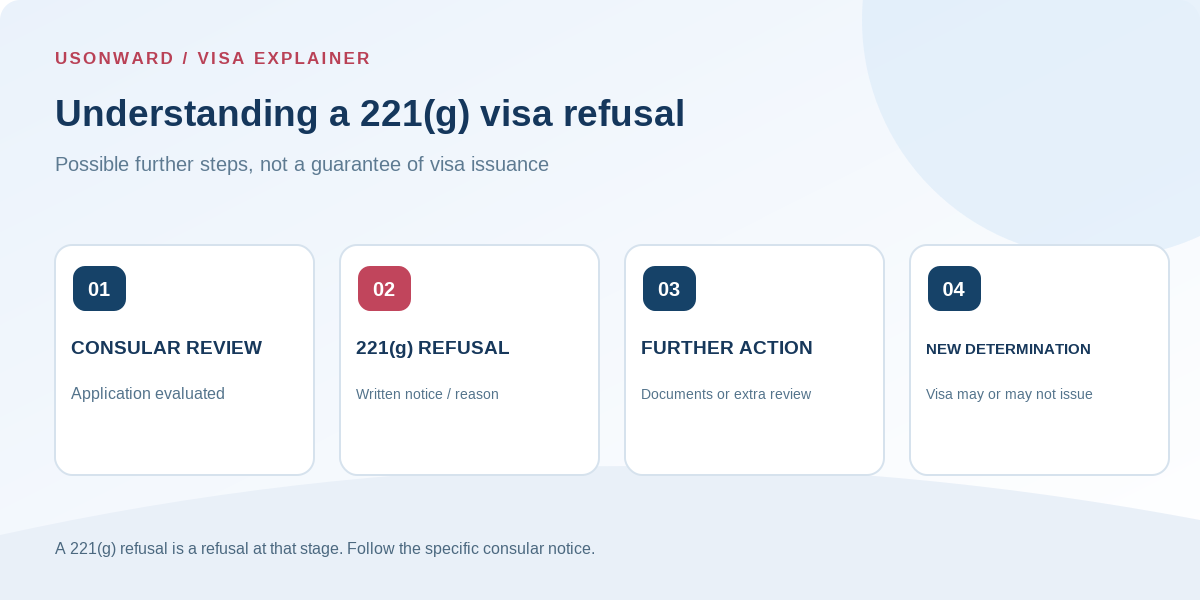
Possible meanings after consular refusal
| Message or process | What it generally means | What to do |
|---|---|---|
| 221(g) refusal | The visa has been refused at the present stage | Read the consulate's written instructions |
| Additional documents | The post requests specific evidence | Use the permitted submission channel |
| Administrative processing | Further consular checks may be needed | Verify current consular guidance; no decision date is assured |
| Subsequent decision | A visa may issue or a refusal may continue | Do not assume approval before actual issuance |
The actual consular notice and Department of State instructions govern the case.
Why CEAC may show a refusal
The Department of State has explained that CEAC case-status displays may show 'Refused' when a visa application is refused under section 221(g), even when further processing or additional documents may still be relevant.
Seeing 'Refused' does not by itself explain the exact reason or confirm that there is no remaining process, but it must not be reinterpreted as approval. Refer to the written consular communication and official status page for case-specific meaning.
What to do when the consulate requests documents
Read the notice carefully. Identify exactly what was requested, which submission channel should be used and whether a deadline is specified. Keep copies of genuine documents and proof of permitted delivery while following the post's actual instructions.
Do not send documents to unsolicited private addresses or intermediaries who claim they can 'clear' administrative checks. If documents involve sensitive facts or prior legal issues, a qualified immigration lawyer can help evaluate the case.
Administrative processing and unpredictable timelines
The duration of additional consular processing can vary by case and may not be reflected in general appointment wait-time estimates. The Department of State publishes information about when and how to inquire, but its guidance and the specific consular post's policies may be updated.
No privately produced calculator can determine a decision date from a CEAC update. Avoid fixed promises about how many days a case will take, or that it must eventually be approved. Important travel plans should account for this uncertainty.
After the review: possible outcomes
If the legal requirements are satisfied after further review, a visa may be issued. A consular officer may also maintain a refusal or make a different determination under applicable law. Issuance is not guaranteed, regardless of how long an applicant waits.
Visa issuance, admission to the United States and any later immigration benefit are separate matters. The Department of State also reminds travelers that a visa does not guarantee entry at a U.S. port of entry.
Protect yourself from misleading status services
Do not enter case credentials, passport numbers or DS-160/DS-260 confirmation details into unofficial tools that promise to predict issuance or accelerate 221(g). Use the Department of State's CEAC service and the relevant consulate's published instructions.
This is general educational information, not legal advice or a prediction about any application. If a case affects urgent travel or difficult legal facts, seek qualified individual assistance.
Steps to review
Use this sequence to organize research. The official agency instructions, not this checklist, control filing requirements.
- 01Confirm the exact language of your consular notice
Determine whether additional documents or administrative processing are described.
- 02Follow the requested submission procedure
Use only the channel and instructions provided by the U.S. consulate.
- 03Check official CEAC case status
Do not infer an approval from a message about additional review.
- 04Review current State Department inquiry guidance
Do not rely on old or fixed processing-time promises.
- 05Avoid nonrefundable commitments based on predictions
Actual issuance and permission to travel remain uncertain until decided.
Frequently asked questions
Is 221(g) a refusal or an approval?
It is a refusal under U.S. visa law at that stage, although the application may be reconsidered under the applicable process.
Why does CEAC say 'Refused' while I have been told about administrative processing?
The Department of State states that 221(g) cases can appear as 'Refused'. Read the consular communication for next steps.
Does administrative processing mean my visa is guaranteed eventually?
No. Issuance depends on meeting the legal requirements after the process is complete.
Can a website predict when administrative processing will finish?
No. Processing varies; use official consular information and current inquiry guidance.
Can I make travel plans before visa issuance?
Avoid assuming issuance or admission before an official decision and the appropriate travel documentation.
Educational information, not legal advice. Immigration laws, agency policies, form editions and deadlines can change. This article does not determine your eligibility. For an individual legal matter, seek help from a qualified U.S. immigration attorney or accredited representative.
Official sources & further reading
Check these original government pages for current instructions, dates and requirements.
- U.S. Department of State — Administrative Processing Information
- U.S. Department of State — Visa Denials
- U.S. Department of State — About Visas FAQs
- CEAC — Official visa status portal
Agency reference pages and core concepts were checked on November 23, 2026. This does not indicate review or approval by a licensed attorney.