
Learn how to retrieve an I-94, what its class and admit-until notation mean, and how it differs from a visa or travel history.
What is an I-94, and who issues it?
Form I-94 is an arrival/departure record used by the U.S. Department of Homeland Security for many nonimmigrant admissions and certain related processes. U.S. Customs and Border Protection (CBP) maintains an online service that can display a traveler's most recent I-94 and travel history when an electronic record is available.
Not everyone entering the United States receives the same type of record, and a CBP admission record is not interchangeable with a visa, passport, Green Card or USCIS approval notice. This article explains common situations but cannot determine the immigration status of an individual traveler.
Where to find the latest I-94 safely
Begin at the official CBP I-94 website, i94.cbp.dhs.gov, or follow the government's current portal directions. The service offers functions such as viewing a recent I-94, travel history and certain compliance information. Access to your personal travel details belongs on the official CBP service, not on a third-party guide.
An I-94 may be electronic rather than a paper form. If you need a copy for an authorized purpose, CBP describes how travelers can print the record. Do not type passport numbers or travel identifiers into USOnward; we provide explanations and official links, not a record lookup.
What an I-94 is — and what it is not
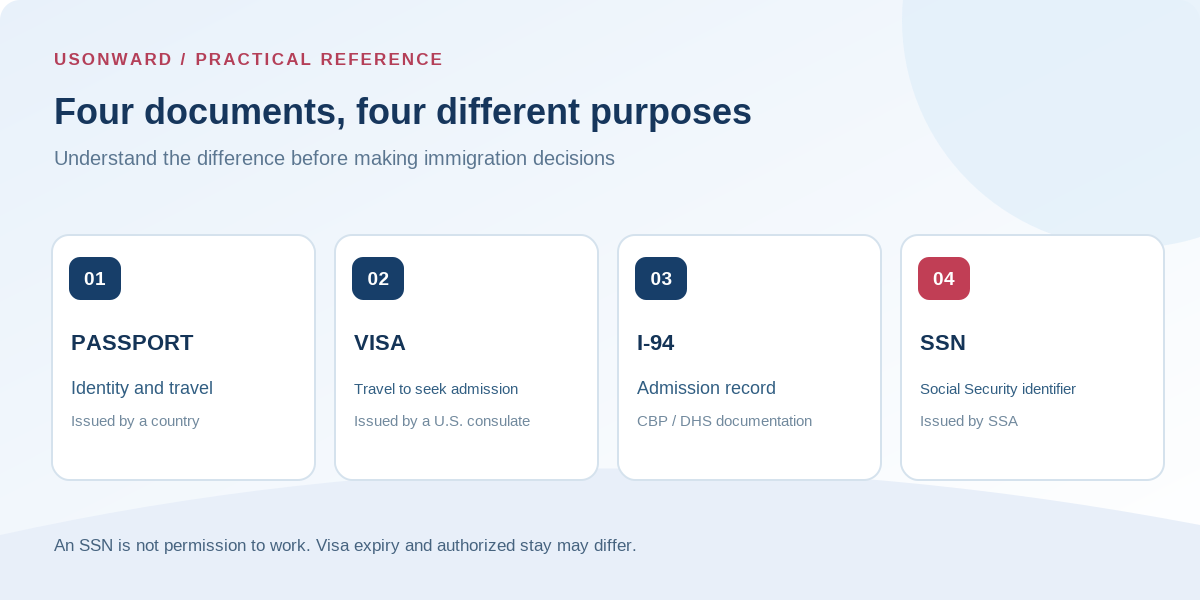
Visa stamp versus I-94
| Record | Generally describes | Does NOT automatically establish |
|---|---|---|
| Visa | Permission to travel and request entry under a category when required | The exact period admitted or unlimited U.S. work permission |
| I-94 | Certain admissions and authorized-stay information from CBP or DHS | A visa, a Green Card or permission for any job |
| Travel history | A display of recorded movements that may help organize dates | A complete legal determination about presence or status |
Review the actual CBP record and any USCIS approval notices relevant to your situation.
Class of admission, date and 'D/S'
Review the class of admission and any 'admit until' notation on the most recent official record. They can be material to understanding the terms of a temporary admission. Some eligible classifications may use a duration-of-status (D/S) notation instead of a fixed calendar date.
An expiration date printed on a visa used to request admission is generally a different concept from the period of stay authorized at entry. An unexpired visa does not by itself extend the period granted by CBP. Depending on the situation, a USCIS approval or later change or extension may also affect a person's documentation; look at the actual notices before making decisions.
Latest I-94 versus travel history
The most recent arrival record provides information about a particular admission. CBP's available travel-history view may show entry and departure events. Those are different views and should not be treated as a complete legal finding about presence, status, or compliance.
Electronic travel-history displays may omit or misclassify some entries and exits. A travel calendar assembled from records can support preparation for naturalization or another filing, but the legal analysis of physical presence and continuous residence is separate.
What if a record cannot be found or seems wrong?
CBP has published guidance for travelers who cannot locate an I-94 online. Potential explanations include differences in passport details or the way records were captured. Follow the official instructions to search and resolve the discrepancy; do not create a new fictitious record or assume a missing result means you were never admitted.
For an apparent entry-record error, use CBP's official help channels. If the question concerns a later USCIS extension, change of status or a more complex history, a lawyer or accredited representative may need to review the specific documentation.
How an I-94 relates to forms and work authorization
Forms such as I-539 and some other benefit applications can ask for admission or I-94 information. An I-94 showing an admission category is not automatically a work permit. Whether the classification permits employment, and under what conditions, is a separate question governed by law and the person's actual documentation.
Never share a copy of your passport or I-94 in a public comment or an unofficial 'status checker.' Check your latest government record and individual USCIS notices before making travel, employment or filing decisions.
Steps to review
Use this sequence to organize research. The official agency instructions, not this checklist, control filing requirements.
- 01Open CBP's official I-94 portal
Use the secure U.S. government portal to review your latest arrival record; do not enter passport data on this site.
- 02Read the class and admit-until notation
Distinguish an entry classification, a fixed end date and any D/S notation.
- 03Compare with the relevant USCIS notices
An extension or change-of-status approval can have its own documentation and conditions.
- 04Check travel-history discrepancies
Use official CBP guidance for missing records or errors; do not infer legal status from an incomplete display.
- 05Protect personal records
Save documents in a secure location and consult qualified help if the history is complicated.
Frequently asked questions
Is my U.S. visa expiration date the same as my I-94 date?
Usually not. The visa generally relates to seeking entry; the period of authorized admission is a distinct question. Review the CBP I-94 and any relevant USCIS notices.
Can I retrieve a recent I-94 online?
Many travelers can view or print an electronic I-94 through CBP's official service. Eligibility and data availability vary.
What does D/S mean?
It usually refers to 'duration of status' for certain classifications, which is not a promise of unlimited lawful stay; other requirements apply.
Does a valid I-94 authorize any job?
No. Employment rules depend on the immigration classification and other applicable authorizations.
Why does my travel history differ from my records?
Electronic travel histories may be incomplete or contain discrepancies. Use CBP's official help resources to investigate.
Educational information, not legal advice. Immigration laws, agency policies, form editions and deadlines can change. This article does not determine your eligibility. For an individual legal matter, seek help from a qualified U.S. immigration attorney or accredited representative.
Official sources & further reading
Check these original government pages for current instructions, dates and requirements.
- CBP — Official I-94 travel website
- CBP Help — Definition of an I-94
- CBP Help — What if the I-94 is not found?
- CBP Help — Electronic I-94 and travel history
Agency reference pages and core concepts were checked on November 23, 2026. This does not indicate review or approval by a licensed attorney.